Governance Health Pilot overview
A stakeholder-ready summary of the Phase A healthcare governance application: API architecture, reusable JSON decision endpoints, compliance posture, and guardrailed AI-assisted decision support.
Phase A scope
Requirement alignment
Each line traces back to the supplied AI Healthcare Governance PDF.
- Medication interaction & allergy checker implemented as the Phase A core system.
- Risk classification supports low, moderate, and high governance outcomes.
- Explanations show why a rule triggered, clinical impact, and required action.
- High-risk prescriptions require controlled escalation and override reason.
- Admin rules are centrally controlled, versioned, and audit-logged.
- AI settings are available for future features, while Phase A remains deterministic.
Source PDF
AI Healthcare Governance PDF
This is the original PDF supplied in the chat, available for direct stakeholder download.
File
AI Healthcare System Architecture-2.pdfAPI architecture
Reusable by any external system
The live pilot now exposes REST/JSON endpoints so hospital portals, EMR/EHR platforms, mobile apps, reporting systems, or other approved clients can integrate without depending on the web UI.
GET /api/v1/architecturereturns the API architecture and machine-readable integration contract.POST /api/v1/prescription-checksaccepts patient, allergy, current medication, and prescribed medication payloads.GET /api/v1/prescription-checks/{id}returns decision status, risk, explanation, patient snapshot, and audit evidence.GET /api/v1/audit-eventsexposes append-only hashed audit events for external audit/reporting systems.GET /api/v1/rulesexposes active/versioned governance rules.
From the source PDF
PDF-based clinical work steps
These steps were taken directly from the supplied AI Healthcare Governance Phase A PDF and translated into the live website workflow.
Patient information, allergy history, medication recommendation, and dosage are submitted.
Drug-allergy and interaction checks detect conflicts such as Penicillin allergy or high-risk combinations.
Known allergy severity, medication compatibility, previous reactions, policy, and confidence score are evaluated.
Unsafe execution is blocked; supervisor review and clinical justification become mandatory.
Triggered rule, severity level, AI + rule validation source, timestamp, and authority are shown.
Supervisor receives escalation, reviews justification, approves/rejects, and all participants are logged.
Doctor identity, supervisor approval, risk evaluation, rule version, outcome, and reasoning are preserved.
The full clinical decision history can be reconstructed with verifiable integrity and accountability.
Original visuals extracted from PDF
Flowchart, layered architecture, and delivery roadmap displayed for stakeholder review.
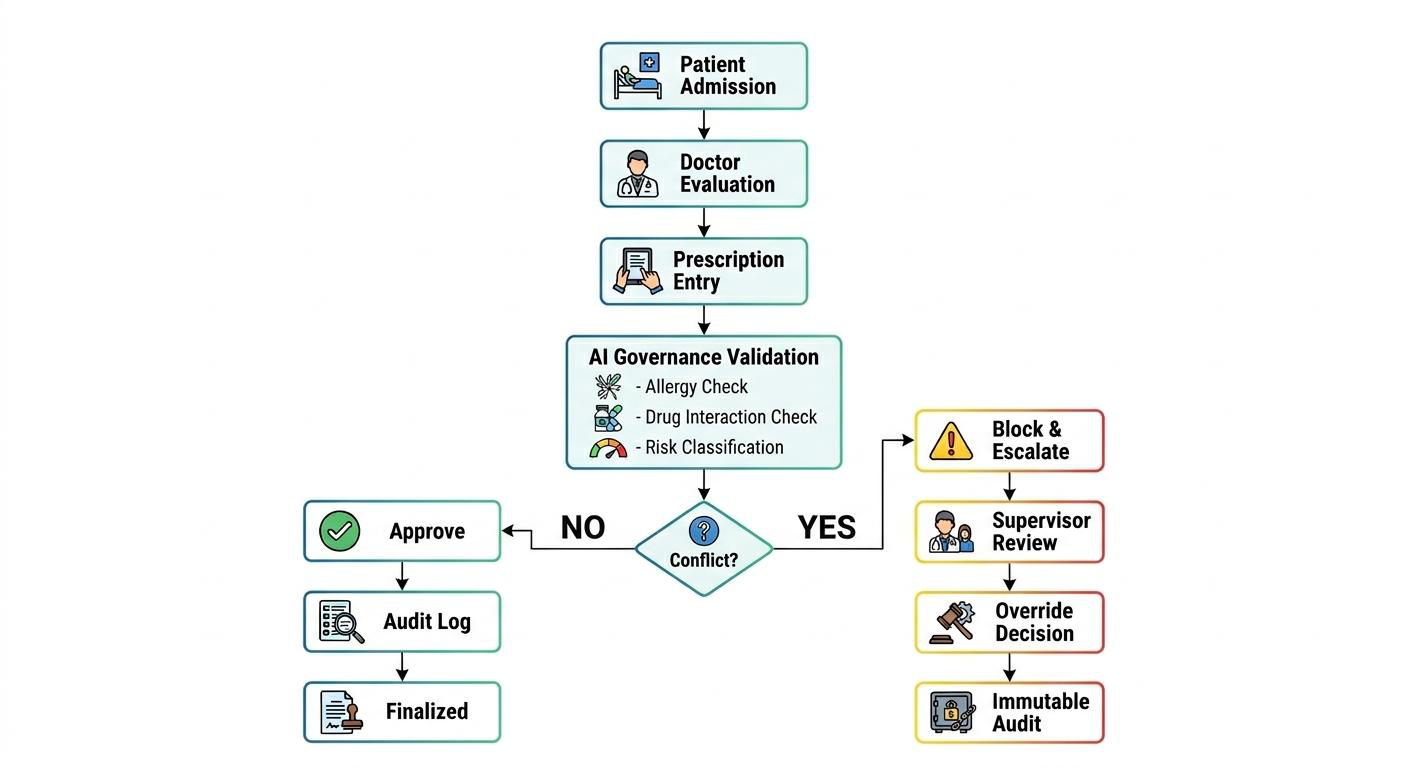
Clinical decision flow chart
Patient admission → AI governance validation → approve or escalate.
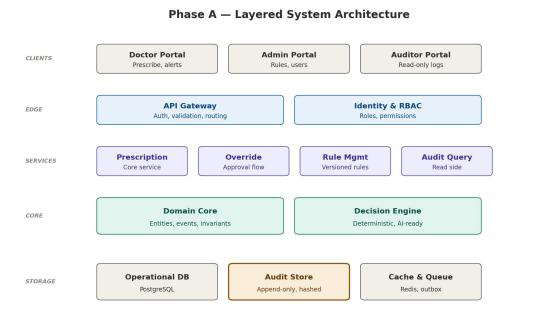
Layered system architecture
Clients, edge, services, core, and storage layers.
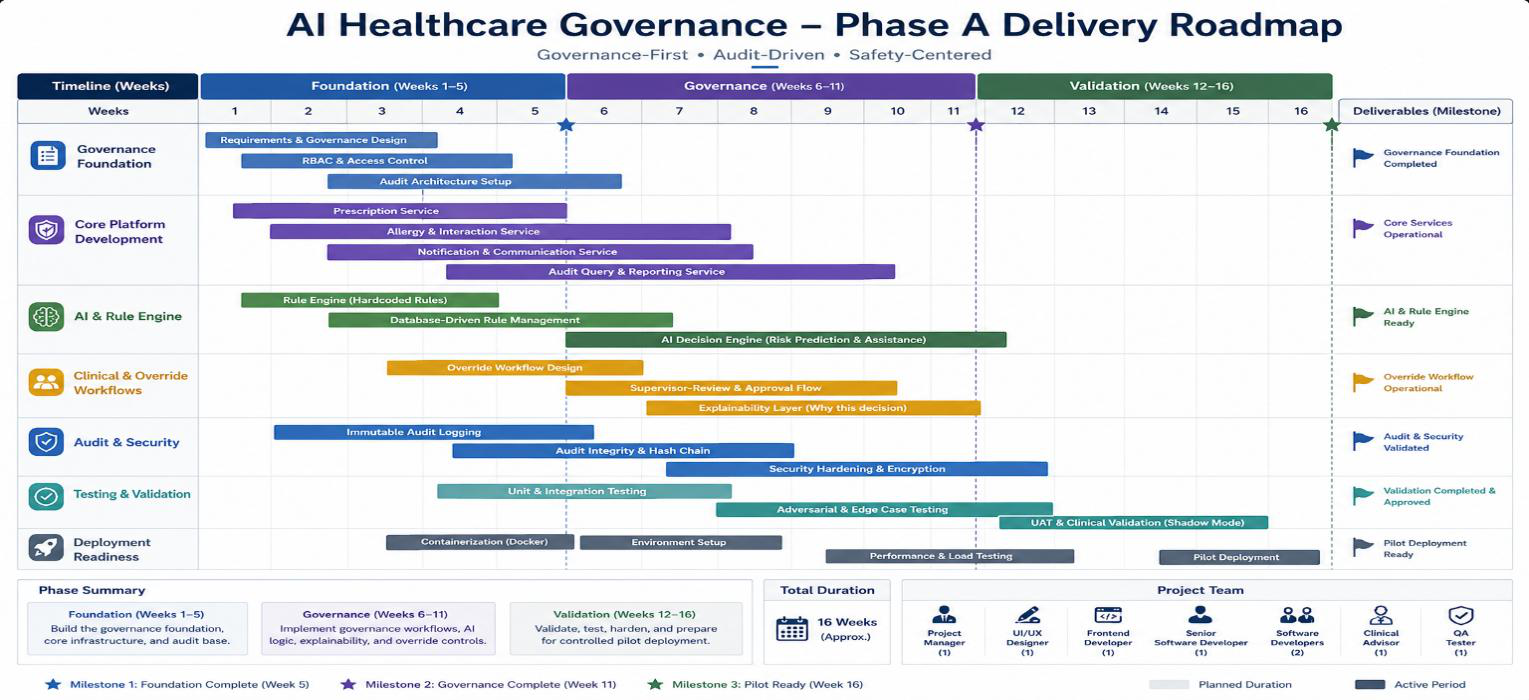
16-week delivery roadmap
Foundation, governance, validation, and pilot-readiness milestones.